Tag: Maternal-Fetal

Maternal mortality remains a pressing public health concern in the United States, reflecting broader disparities in healthcare access and outcomes. As we move through 2024, it’s crucial to understand the current state of maternal mortality, examine statistics, and learn more about ongoing efforts to address the persistent challenges. 

 According to the Centers for Disease Control and Prevention (CDC), the maternal mortality rate in the United States was 32.9 deaths per 100,000 live births in 2021, the most recent year for which complete data is available. This rate, significantly higher than in other high-income nations, underscores the need for systemic improvements within our healthcare system. 

Furthermore, provisional data for 2024 continues to reveal concerning trends. Maternal mortality rates fluctuate, with racial disparities remaining a significant concern. Black women are “about three times more likely to die from pregnancy-related causes compared to white women.” (CDC, 2024) 

Social determinants of health significantly impact maternal outcomes. Factors such as housing instability, transportation access, food insecurity, substance use, violence, and systemic racial and economic inequalities all play a role in maternal health disparities. 

Efforts to tackle these disparities include supporting state perinatal quality collaboratives and initiatives like the Hear Her campaign, aimed at raising awareness and fostering better communication between healthcare providers and patients, particularly those from underserved communities. 

Several initiatives are underway to combat maternal mortality by enhancing healthcare quality and addressing health disparities: 

  1. Enhancing Reviews and Surveillance to Eliminate Maternal Mortality (ERASE MM) Program: This program supports states in understanding the drivers of maternal mortality and developing prevention strategies through comprehensive reviews of maternal deaths. 
  1. Perinatal Quality Collaboratives (PQCs): These state-based collaboratives strive to enhance the quality of care for mothers and infants, with CDC support focusing on improving equity in care and outcomes. 
  1. CDC Levels of Care Assessment Tool (LOCATe): LOCATe assists states in standardizing their assessments of maternal and newborn care levels in hospitals, ensuring healthcare facilities are adequately equipped to meet patient needs. 
  1. Hear Her Campaign: This campaign raises awareness about warning signs of potentially life-threatening complications during and after pregnancy, promoting better communication between patients and healthcare providers for timely and effective care. 

In addition to CDC initiatives, there are legislative efforts to address maternal mortality. The Black Maternal Health Momnibus Act, for instance, is a comprehensive package of bills aimed at improving maternal health outcomes, particularly for Black women and other women of color. It includes provisions for improving data collection, investing in community-based organizations, and diversifying the perinatal workforce. 

Programs like the Special Supplemental Nutrition Program for Women, Infants, and Children (WIC) are also combating maternal mortality and addressing maternal healthcare deserts, areas where women face significant barriers to accessing maternity care. 

Technology can also help combat maternal mortality. Telehealth services, for example, can bridge the gap for mothers in healthcare deserts, enabling them to access vital prenatal and postnatal care remotely. Additionally, digital health platforms can provide educational resources, monitor maternal health indicators, and facilitate communication between patients and healthcare providers, ensuring timely interventions and support. 

The maternal mortality crisis in the United States remains a significant public health challenge in 2024. However, through comprehensive efforts to improve healthcare quality, enhance access, and reduce racial and ethnic disparities, progress can be made. Initiatives by the CDC, legislative endeavors such as the Black Maternal Health Momnibus Act, and leveraging technology all play pivotal roles in creating a safer and more equitable healthcare system for all mothers. By continuing to monitor and address the factors contributing to maternal mortality, we can strive toward a future where every mother has the chance to thrive. 
Maternal care deserts are areas with a lack of access to essential maternal healthcare services, such as:

  • Prenatal care
  • Labor and delivery services
  • Postpartum care

Due to the lack of available care, women face considerable challenges in accessing timely, adequate care. This can lead to adverse health outcomes both for the mothers and the infants.

Limited Access to Health Facilities

Maternal care deserts have few or no hospitals, clinics, or healthcare providers offering maternal health services. Women living in these areas must travel long distances to reach facilities and receive care.

Shortage of Healthcare Professionals

There is a shortage of obstetricians, gynecologists, and other maternal care providers in these areas, leading to care delays and overburdened existing providers.

Lack of Specialized Care

For some areas, even when access to basic care is available, access to specialized care is limited. This can include care for high-risk pregnancies or complications during childbirth.

Higher Rates of Maternal and Infant Mortality

Due to inadequate access to care, maternal healthcare deserts often have higher rates of maternal and infant mortality and morbidity. Women in these areas are more likely to experience complications during pregnancy and childbirth.

Health Disparities

Maternal healthcare deserts exacerbate existing health disparities, particularly affecting low-income women, women of color, and those in rural communities. This contributes to overall poorer health outcomes and can perpetuate cycles of poverty and ill health.

Addressing the issue of maternal healthcare deserts involves a multifaceted approach, including increasing the number of healthcare providers in underserved areas, improving transportation and infrastructure, expanding telehealth services, enhancing healthcare coverage, and addressing social determinants of health.

Several organizations, government agencies, and initiatives are working to address maternal health care deserts. Their efforts aim to improve access to maternal health services and reduce disparities in maternal and infant health outcomes.

Government Agencies:

  • Health Resources and Services Administration (HRSA): HRSA runs programs aimed at improving access to health care in rural and underserved areas, including the Maternal and Child Health Bureau, which supports maternal and child health services.
  • Centers for Medicare & Medicaid Services (CMS): CMS provides funding and policy guidance to improve maternal health care access and quality through programs like Medicaid and the Children’s Health Insurance Program (CHIP).
  • National Health Service Corps (NHSC): This program provides scholarships and loan repayment to health care providers who commit to working in underserved areas, including maternal health care providers.

Nonprofit Organizations:

  • March of Dimes: This organization advocates for policies that improve maternal and infant health, funds research, and provides resources to support mothers and babies in underserved areas.
  • Every Mother Counts: Founded by Christy Turlington Burns, this nonprofit works to make pregnancy and childbirth safe for every mother, everywhere, by supporting programs that improve access to essential maternity care.
  • Black Mamas Matter Alliance (BMMA): BMMA focuses on improving maternal health outcomes for Black women through advocacy, research, and support for community-based organizations.

Community Health Initiatives:

Telehealth Initiatives:

  • Project ECHO (Extension for Community Healthcare Outcomes): This model uses telehealth to connect primary care providers in rural and underserved areas with specialists, including maternal health experts, to improve care delivery.
  • Telehealth Resource Centers: Funded by HRSA, these centers support the expansion and implementation of telehealth services, which can be particularly beneficial for prenatal and maternal health care in remote areas.

Policy and Advocacy Efforts:

Advancements in ultrasound reporting and telehealth play a crucial role in enhancing access to quality care and improving health outcomes for mothers and infants. These technologies facilitate remote consultations, prenatal care monitoring, and emergency support and leverage data analytics to identify trends, predict high-risk pregnancies, and allocate resources effectively.

By adopting these strategies and leveraging the efforts of government agencies, nonprofit organizations, community health initiatives, and technological advancements, we can make significant strides in closing the gap in maternal health care and ensuring that all women receive the care they need for healthy pregnancies and childbirths.

The way patients are diagnosed, treated, and cared for is undergoing significant transformation in maternal-fetal medicine (MFM). Artificial intelligence (AI) is emerging as a powerful tool in enhancing diagnostic accuracy, optimizing workflows, and fostering equitable access to healthcare. But there are many profound implications of AI in MFM, which were discussed in a recent panel, “Exploring the Expanding Role of Artificial Intelligence in Maternal-Fetal Medicine” that featured clinicians and experts at the SMFM 2024 Pregnancy Meeting.

The speakers and panelists included: Jeanne Sottile, RDMS RVT CSPO of AS Software; University of Kentucky College of Medicine’s Maternal Fetal Medicine Fellow Physician, Dr. Neil Bharat Patel; CEO of Ultrasound AI, Robert Bunn; Chief Medical Offer and Professor, Dr. Garrett K.Lam, of Intermountain High Risk Pregnancy Center and University of Kentucky; and Martin Mienkina, PhD, Advanced Technology and Innovation Manager at GE Healthcare.

Here is a breakdown into the key insights that emerged of the multifaceted applications of AI, challenges, opportunities, and its potential to reshape patient outcomes.

The establishment of trust in algorithmic insights is central to the integration of AI into MFM.

Rigorous testing methodologies are paramount to validate AI algorithms, ensuring consistency and persistence of results across diverse patient populations and clinical settings.

Transparency and trust will build the foundation of successful adoption and utilization of new AI technologies, ensuring that AI-driven innovations enhance, rather than compromise, patient care.

A compelling aspect of AI in MFM is its capacity to democratize healthcare access.

By mitigating skill barriers through technologies like AI-assisted ultrasound, AI enables less specialized practitioners to perform basic examinations with greater accuracy. This innovation is especially promising for underserved rural and international communities, where access to specialized care can be limited.

AI algorithms, like those that can predict preterm birth, represent a large shift in diagnostic approaches.

These algorithms transcend conventional anatomical markers like the cervix, leveraging digital signals within ultrasound images to discern subtle patterns and correlations. AI can ‘see’ beyond human perception and analyze a spectrum of anatomical areas (like the ovaries, uterus, and placenta).

By processing vast amounts of data in real time, AI algorithms can detect early indicators of complications, leading to timelier interventions and improved patient outcomes.

Ensuring equitable access to AI-driven healthcare solutions is a critical consideration in the adoption of AI in MFM.

Some collaborative efforts underway include the development of solutions tailored for low-resource settings, supported by organizations like the Gates Foundation. By leveraging AI to bridge healthcare gaps globally, these initiatives aim to advance maternal and fetal health outcomes worldwide.

The equitable dissemination of AI solutions in MFM extends beyond merely providing access to technology. It involves tailoring solutions to suit the needs of diverse populations and addressing systemic barriers to healthcare access. By prioritizing inclusivity and accessibility, AI-driven innovations have the potential to revolutionize maternal and fetal healthcare delivery.

From enhancing diagnostic precision to optimizing workflows and fostering equitable access to healthcare, AI promises to transform patient care in MFM. However, realizing this potential requires collaborative efforts, rigorous testing methodologies, and regulatory oversight to ensure the reliability, validity, and accessibility of AI technologies.

As the healthcare industry navigates the intersection of AI and healthcare, the future of maternal-fetal medicine holds promise for improved patient outcomes and enhanced quality of care.


Learn more about AS Software’s approach to AI: AI in Ultrasound Reporting: Driving Efficiency and Automation

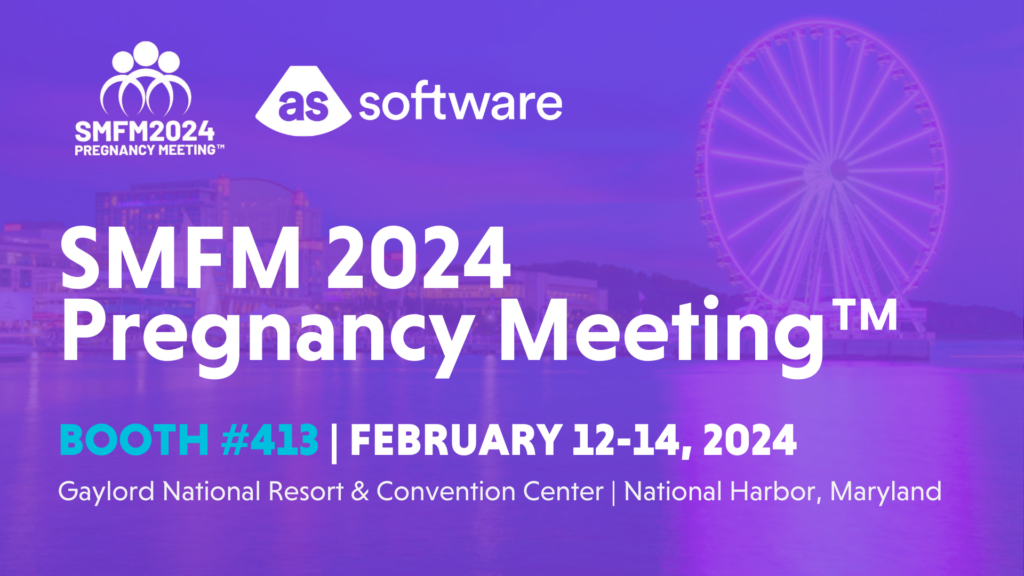
Join the AS Software Team at Booth 413

February 12 — February 14, 2024

This meeting provides an excellent opportunity to learn from leaders in the field of maternal-fetal medicine and to connect with colleagues from around the world. To learn more and register, visit the SMFM 2024 event site.

  • Reduce your workload with more efficient reporting
  • Future-proof your ultrasound workflows with AI solution integration
  • Capture and share crucial ultrasound data when you need it, where you need it
  • Decrease billing and documentation errors
  • Integrate seamlessly with your EHR and other technologies
  • Our patient-facing image sharing solution
  • Our AI integration capabilities

David Lintz
CEO

Connect with David

Jeff Schmidt
VP, Sales

Connect with Jeff

Mark Scott

Connect with Mark

Derek DellaVecchia
RDMS, RDCS, RVT, RMSR

Senior Account Executive

Jeanne Sotille
RDMS, RVT, CSPO

Product Manager

Thank you for joining us!

The 2023 Conference was a great time to connect with you to learn and collaborate together on delivering the smartest solutions for Women’s Health.

Request a demo

If we didn’t have a chance to meet at the conference, our team would be happy to meet with you. Request a demo and we can share how we can help:

  • Deliver better support to clinicians
  • Reduce documentation time
  • Alleviate technology burdens

Conference attendees

Derek DellaVecchia

Senior Account Executive

Connect with Derek

Ben Carlo

Senior Account Executive

Connect with Ben

Event information

Location: University of North Carolina at Chapel Hill

100 Friday Center Drive

Chapel Hill, NC

Dates: April 19 – 21, 2023

The 2023 Society for Maternal-Fetal Medicine (SMFM) 42nd Annual Pregnancy Meeting was a great opportunity to exchange ideas, new science, and successes in Maternal-Fetal Medicine (MFM).  

We enjoyed the opportunity to meet leaders, friends, and partners in MFM and were able to hear what was on everyone’s minds in the world of ultrasound and reporting systems for the upcoming year.  

Here are some of our key takeaways from the top topics that were trending at the event: 

Bringing Practice Insights to Life with Integrated Applications to Further Research and Measure Performance 

How can you uncover key trends in ultrasound and forecast for practice growth?  

A very creative solution was shared with us by a physician who uses the Microsoft Business Intelligence (Microsoft BI) tool in combination with the AS Software SQL Database. Microsoft BI analyzes “historical and current data and presents findings in intuitive visual formats … to transform raw data into easy-to-digest insights for everyone in the organization to use.”  

This application, combined with data flowing from AS Software, creates dashboards with data analytics for the practice across its multiple locations.  

They can use it to visualize patient volume, number of ultrasounds performed, completed reports by physician, and more to evaluate overall performance, and measure and plan for practice growth. Patient demographics, raw ultrasound data, and report findings are also used to capture case trends that inform research and aid in diagnosis. 

Using Cloud Technology to Drive Scalability 

How can you remove internal barriers to problem solving at your practice and alleviate IT burdens? 

When switching from local installations to a cloud-hosted solution, organizations greatly reduce burdens and responsibilities that are placed on internal IT teams. Now they have fewer technical issues, and updates, upgrades and fixes are addressed more rapidly by the technology vendor. 

Cutting out these barriers to prompt problem resolutions has really resonated with users who are finding less headaches and more efficiencies with a cloud-hosted system. 

Staying current with the most optimized reporting technology was an increasing priority for clinicians at this year’s SMFM meeting. And learning how to leverage your technology in new and creative ways is proving beneficial to clinicians and practice administration.  

We’re excited to continue developing features that deliver the most value for our customers and look forward to many more events with friends and peers in the industry!  

Want to discuss industry topics with our team of clinical experts? Schedule a demo.  


Nasrin Benion, MBA, RDMS is the Director of Clinical Ultrasound Solutions and brings over 15 years of hands-on industry expertise to AS Software. 

Get to know Nasrin better through her spotlight interview and connect with her on LinkedIn! 

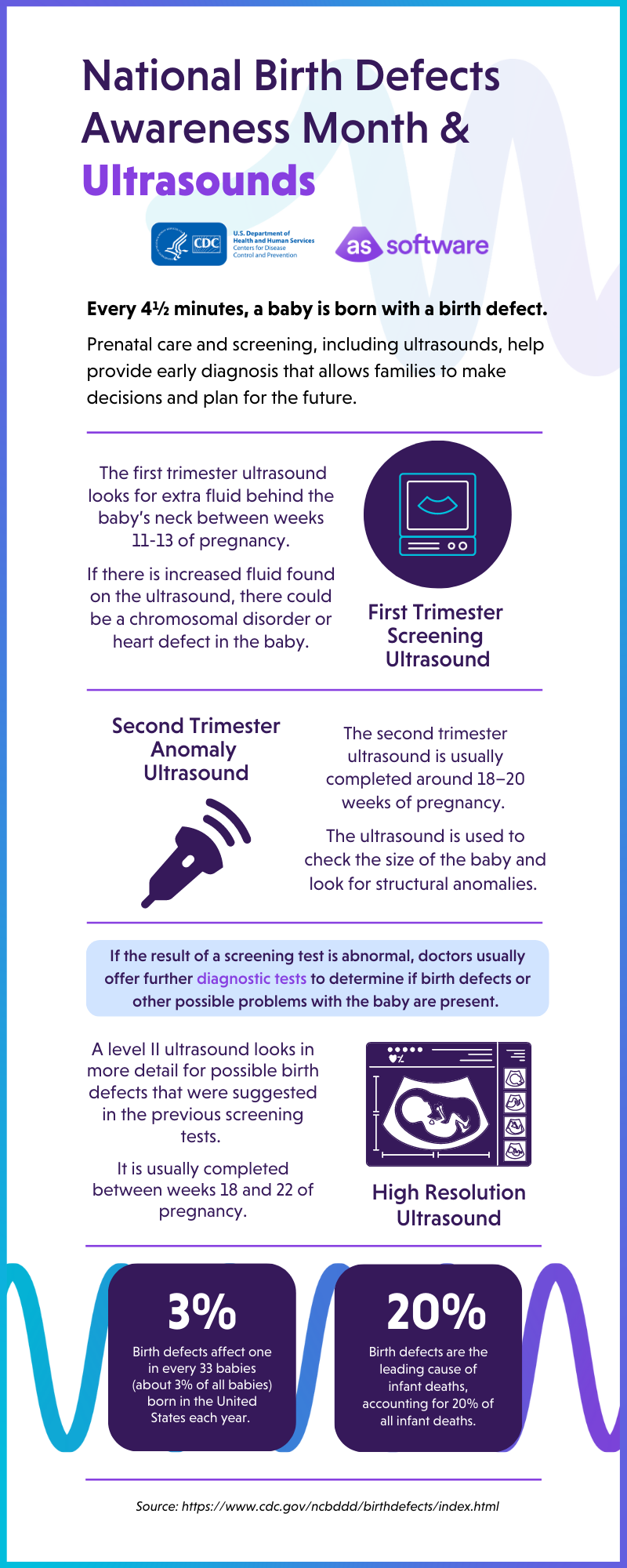
January is National Birth Defects Awareness Month, a time to raise awareness for birth defects and their impact on the health and well-being of families, individuals, and parents.

Nearly 120,000 babies are affected by birth defects each year, which can occur during any stage of pregnancy. Birth defects are also a leading cause of infant mortality in the U.S., accounting for 1 in 5 infant deaths, and in the U.S. each year, the total hospital costs of children with birth defects exceed $2.6 billion. (CDC.gov)

Screening and diagnostic ultrasounds are an important part of prenatal care, helping to provide diagnosis that allows families to make decisions and plan for the future.

Download and view an infographic on ultrasounds and National Birth Defects Awareness Month and view more resources below.

Resources for National Birth Defects Awareness Month

Data and Statistics on Birth Defects

Educational and Other Resources for Sharing

Birth Defects and Infant Disorders Resources

Awareness of Birth Defects Across the Lifespan

Learn more at www.cdc.gov/ncbddd/birthdefects

Thank you for joining us! 

We enjoyed catching up with everyone at the Society for Maternal Fetal Medicine (SMFM) Annual Pregnancy meeting. It was a great opportunity to meet with leaders in Maternal-Fetal Medicine and learn from their groundbreaking research in pregnancy science. We got to participate in scientific sessions, workshops, oral and poster abstract presentations, networking opportunities, and more.

Need a lift to the cloud?

If you did not get a chance to top by our booth and learn more about our innovative cloud solution for more streamlined workflows, be sure to schedule a demo with our team to learn more. While you’re there, enter for a chance to win a drone.

We look forward to speaking with you!

2023 Attendees

David Lintz

CEO Connect with David

Ari Sandman

Founder Connect with Ari

Nasrin Benion

Director, Clinical Ultrasound Solutions Connect with Nasrin

Mark Scott

VP of Sales Connect with Mark

Taylor Brammer

Senior Account Executive Connect with Taylor

Event Information and Dates

Moscone West Convention Center

Exhibit Hall Hours

AS Software Booth Number: 727

Wednesday, February 8th, 12:00-6:00 pm

Thursday, February 9th, 10:30-6:00 pm

Friday, February 10th, 10:00 am-5:00 pm

Dr. Michael Ruma, MD, MPH, FACOG is a Maternal-Fetal Medicine Specialist for Perinatal Associates of New Mexico, a leader in outstanding high-risk pregnancy care. Watch as he shares how AS Software helped his practice grow and thrive while saving valuable time previously spent on ultrasound documentation.  

Challenge

Without an automated ultrasound reporting system in use, clinicians at Perinatal Associates of New Mexico were limiting time with patients to manually type ultrasound reports and locally print them. The inefficient ultrasound documentation process was a large time burden hindering growth at the practice. 

Solution

Dr. Ruma engaged AS Software to help drive efficiency by automating and organizing the reporting and review process: 

  • Allowing all images to be easily accessed remotely, from anywhere in the world 
  • Efficiently creating high-quality, succinct reports for referring providers that are easy to read 
  • Quickly faxing and sending information through integration with Greenway EHR
Quote

“A dramatic amount of growth happened over the last decade because AS Software allows us to be highly efficient and organized, with great connectivity to electronic medical records.”
Dr. Michael Ruma
President, Perinatal Associates of New Mexico

Results

AS Software automation significantly reduced the time required to create an ultrasound report from 5-7 minutes to 30-60 seconds. This efficiency enabled the practice to expand services, accommodate more patients, and establish additional offices and satellite sites. In the first year alone, the practice increased its study volume while reducing documentation time by 86%*.

Quote

“We were able to move through the day faster and more efficiently, which allowed us to see more patients and ultimately achieve financial improvement,” noted Dr. Ruma

In the first full year of using AS Software, Perinatal Associates of New Mexico experienced a 23% increase in patient volume, resulting in a $315,000 increase in practice revenue.

Dr. Ruma and the team at Perinatal Associates of New Mexico continue to partner with AS Software to optimize their healthcare practice, achieving significant improvements in staff efficiency, business growth, and patient outcomes.

Learn more about reducing ultrasound documentation time with automation: Get a Demo 

*This percentage is determined conservatively by taking the higher end of the initial timeframe—7 minutes, or 420 seconds—and comparing it to the higher end of the post-automation time of 60 seconds. By subtracting the post-automation time from the pre-automation time, dividing by the pre-automation time, and multiplying by 100, we find that each report now takes 360 seconds less to complete, multiplying savings across each report and significantly increasing the practice’s efficiency.